


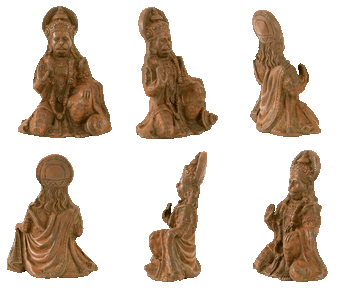
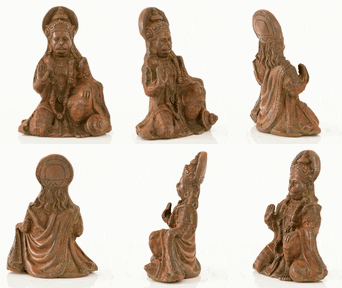
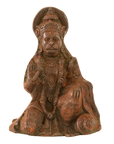
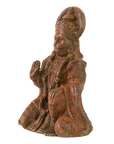
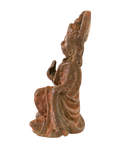




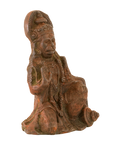
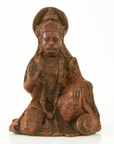
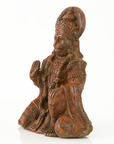
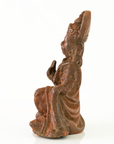
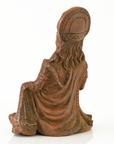
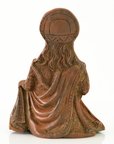
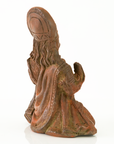
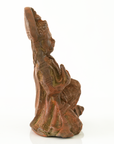
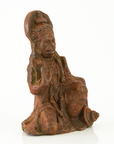
Kneeling Sindoor Hanuman Murti
Hanuman, the Son of the Wind, is one of the great embodiments of bhakti—devotion, courage, strength, perseverance, and selfless service. Revered as the devoted servant of Lord Rama, he represents the understanding that within each of us lies an unlimited power, often hidden and waiting to be awakened. Hanuman reminds us that, with faith, devotion, and courage, nothing is impossible.
This Hanuman murti is depicted in a kneeling pose of utter devotion, with one hand raised in blessing and the other holding the soldier’s mace. His helmet and powerful bearing evoke the strength and purity of the Perfect Servant; one who uses his immense power not for himself, but in service to others. Hanuman is traditionally called upon for protection, courage, strength, and assistance in overcoming obstacles and difficulties.
The orange-red covering of sindoor (vermilion) on Hanuman is an especially meaningful expression of his devotion to Lord Rama. According to a beloved story from the Ramayana, Hanuman once saw Sita applying sindoor to her forehead. When he learned that she wore it as an expression of love and devotion to Rama, and that it was believed to bless Rama with long life, Hanuman was deeply moved. He reasoned that if a small amount of sindoor could bring such blessings, then covering his entire body in it would ensure Rama’s immortality. Thus, his complete covering in sindoor came to symbolize his absolute devotion, loyalty, and selfless love for Rama.
For this reason, Hanuman murtis are traditionally adorned with sindoor, often mixed with sesame oil and applied during puja. While sindoor is traditionally red, many Hanuman statues appear bright orange, reflecting the use of saffron (kesar) or orange-colored sindoor.
Murtis are often used for puja and placed upon an altar, but Hanuman may also be placed elsewhere in the home as a reminder of his protection, grace, courage, and unwavering devotion. His presence invites us to remember the strength that lies within us and to meet life’s challenges with faith, humility, and courage.


